Introduction
Cocoa is one of the world’s most valuable agricultural products and serves as the foundation for a wide range of food and beverage applications. From premium desserts and bakery products to beverages and confectionery, every high-quality cocoa ingredient begins its journey with carefully processed cocoa beans.
Understanding cocoa bean processing is essential for manufacturers, chocolatiers, bakers, and food businesses looking to source premium-quality cocoa ingredients. Every stage—from harvesting fresh cocoa pods to roasting, grinding, and pressing—plays a crucial role in determining the final flavor, aroma, texture, and quality of cocoa products.
In this comprehensive guide, we’ll explore how cocoa beans are processed, explain every stage of the cocoa bean manufacturing process, and show how each step contributes to producing high-quality cocoa ingredients such as Cocoa Butter, Cocoa Powder, Cocoa Mass, and Cocoa Nibs.
At Walksea Industries, we specialize in manufacturing and supplying premium cocoa ingredients for bakeries, confectionery brands, beverage manufacturers, HORECA businesses, and food processing industries. Our carefully sourced cocoa products are processed to meet high-quality standards while delivering consistent flavor and performance.
What is Cocoa Bean Processing?
Cocoa bean processing refers to the complete transformation of freshly harvested cocoa beans into valuable cocoa ingredients used across the food industry. The process involves several carefully controlled stages that enhance the beans’ natural flavor while removing moisture, impurities, and bitterness.
The complete cocoa processing journey includes:
- Harvesting ripe cocoa pods
- Extracting fresh cocoa beans
- Fermentation
- Drying
- Cleaning & Sorting
- Roasting
- Winnowing
- Grinding
- Pressing into cocoa butter and cocoa cake
- Milling cocoa cake into cocoa powder
Each stage of the cocoa production process directly influences the taste, color, aroma, and functionality of the finished cocoa products.
Learn more about our premium Cocoa Beans product page here: https://walkseaindustries.com/cocoa-beans/
Step 1: Harvesting Ripe Cocoa Pods
The cocoa bean manufacturing process begins on cocoa farms, where ripe cocoa pods are carefully harvested from cacao trees. Farmers typically use sharp knives or harvesting hooks to cut mature pods without damaging the tree.
A cocoa pod generally takes around 5 to 6 months to mature. Only fully ripened pods are selected because they contain beans with the best flavor potential and proper sugar content required for fermentation.
Harvesting at the correct stage is critical because immature or overripe pods can negatively affect the quality of the final cocoa ingredients.
Key Highlights
- Pods are harvested manually.
- Only mature pods are selected.
- Proper harvesting ensures consistent bean quality.
- Healthy beans lead to superior cocoa products.
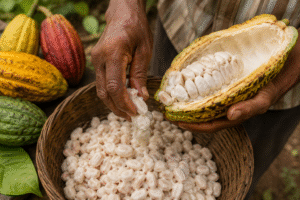
Step 2: Extracting Cocoa Beans
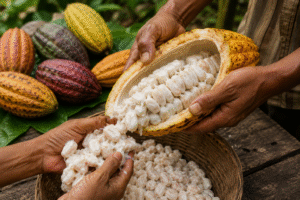
After harvesting, the cocoa pods are transported to the processing area, where they are carefully split open using wooden clubs or machetes.
Inside every pod is approximately 30–50 cocoa beans, surrounded by a sweet white pulp. These freshly extracted beans are the raw material for all cocoa products.
At this stage, the beans have very little chocolate aroma. Their characteristic flavor develops during the next stage—the cocoa bean fermentation process.
Fresh beans are carefully collected while damaged or diseased beans are removed to maintain product quality.
Why This Step Matters
- Removes beans from the pod.
- Preserves bean quality.
- Eliminates damaged beans.
- Prepares beans for fermentation.
Discover our premium-quality Cocoa Nibs & Cocoa Beans used by food manufacturers and bakeries.
Step 3: Cocoa Bean Fermentation Process
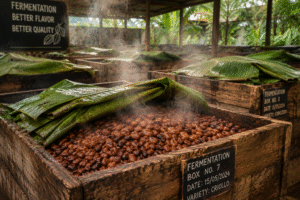
The cocoa bean fermentation process is one of the most important stages in cocoa processing. Without proper fermentation, cocoa beans would remain bitter, acidic, and lack the rich flavor expected in premium cocoa products.
Fresh beans are placed inside wooden fermentation boxes or covered with banana leaves for 5 to 7 days. During this period, naturally occurring microorganisms convert the sugars in the pulp into alcohol and organic acids, generating heat that initiates essential biochemical changes inside the beans.
Fermentation develops the characteristic cocoa flavor, reduces bitterness, enhances color, and prepares the beans for roasting.
Benefits of Proper Fermentation
- Develops rich cocoa flavor.
- Reduces bitterness and astringency.
- Improves aroma.
- Enhances bean color.
- Creates the foundation for premium cocoa products.
At Walksea Industries, maintaining consistency throughout the fermentation stage is essential to ensuring the high quality of our cocoa ingredients.
Explore our range of premium cocoa ingredients including Cocoa Mass, Cocoa Butter, and Cocoa Powder for industrial applications.
Step 4: Drying the Cocoa Beans
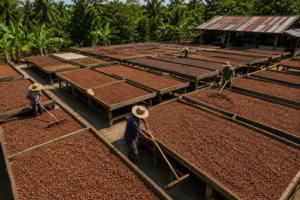
Once fermentation is complete, the cocoa beans contain around 55–60% moisture, which is too high for safe storage and further processing. The next critical stage in cocoa bean processing is drying, where the moisture content is gradually reduced to approximately 6–8%.
Traditionally, fermented beans are spread evenly on large drying mats, wooden platforms, or concrete patios under direct sunlight. They are turned several times a day to ensure uniform drying and prevent mold growth. In regions where sunlight is limited or large-scale production is required, mechanical hot-air dryers are also used to achieve consistent results.
Proper drying is essential because excessive moisture can lead to fungal contamination, while over-drying may reduce the quality and flavor of the beans.
Benefits of Proper Drying
- Reduces moisture for safe storage.
- Prevents mold and microbial growth.
- Improves shelf life.
- Preserves flavor compounds developed during fermentation.
- Prepares beans for roasting.
After drying, the beans are packed into jute bags and transported to cocoa processing facilities for further manufacturing.
Looking for premium-quality cocoa ingredients? Explore our Cocoa Beans and Cocoa Nibs designed for food manufacturers, bakeries, and confectionery industries.
Step 5: Cleaning and Sorting
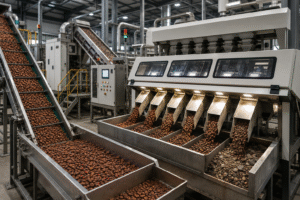
Before roasting begins, dried cocoa beans undergo a thorough cleaning and sorting process. This stage ensures that only high-quality beans move forward in the manufacturing process.
Modern cocoa processing plants use a combination of sieves, vibrating screens, magnets, aspiration systems, and optical sorting machines to remove impurities such as
- Dust
- Stones
- Twigs
- Metal particles
- Broken beans
- Foreign materials
After cleaning, beans are sorted according to their size and quality. Uniform bean size is important because it allows even roasting, resulting in consistent flavor development.
At Walksea Industries, stringent quality checks are performed during this stage to ensure every batch meets food industry standards.
Why Cleaning Matters
- Removes foreign materials.
- Ensures food safety.
- Improves roasting consistency.
- Enhances final product quality.
- Minimizes processing losses.
High-quality cleaning is one of the reasons why premium cocoa ingredients deliver better performance in bakery, confectionery, and beverage applications.
Browse our premium range of Cocoa Husk and Cocoa Beans for industrial applications.
Step 6: Cocoa Bean Roasting Process
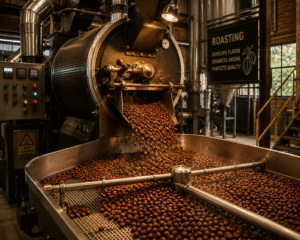
The cocoa bean roasting process is where cocoa truly begins to develop its rich aroma and characteristic flavor. Roasting is one of the most carefully controlled stages because temperature and roasting time directly influence the taste, color, and quality of the final cocoa products.
Typically, cocoa beans are roasted between 110°C and 150°C, depending on the bean origin, moisture level, and desired flavor profile.
During roasting:
- Remaining moisture evaporates.
- Flavor compounds become more pronounced.
- Bitterness is reduced.
- Aroma intensifies.
- Bean shells become brittle for easier removal.
Every cocoa manufacturer uses different roasting profiles to achieve specific flavor characteristics. Light roasting preserves fruity and floral notes, while medium and dark roasting create deeper cocoa flavors preferred for bakery and confectionery products.
Benefits of Proper Roasting
- Enhances cocoa aroma.
- Develops rich chocolate notes.
- Reduces bitterness.
- Improves color.
- Makes shell removal easier.
- Improves grinding efficiency.
Consistent roasting plays a significant role in producing premium cocoa ingredients with reliable taste and functionality.
At Walksea Industries, roasting parameters are carefully monitored to maintain consistent quality across every batch of cocoa products.
Discover our premium Cocoa Powder and Cocoa Butter, produced using carefully processed cocoa beans for superior quality and performance.
Step 7: Cracking and Winnowing
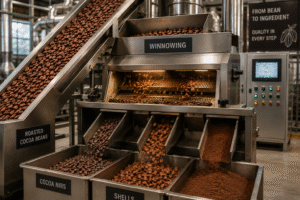
Once the cocoa beans have been roasted and cooled, the next stage in the cocoa bean manufacturing process is cracking and winnowing. During this process, the roasted beans are cracked into smaller pieces, allowing the thin outer shell to separate from the edible cocoa nib.
Specialized winnowing machines use airflow to remove the lightweight shells while retaining the heavier cocoa nibs. These nibs are the purest form of cocoa and serve as the foundation for producing cocoa mass, cocoa butter, and cocoa powder.
Proper winnowing is essential because even a small amount of shell can affect the flavor, texture, and quality of the finished cocoa products.
Benefits of Cracking & Winnowing
- Separates cocoa nibs from shells.
- Improves product purity.
- Enhances cocoa flavor.
- Prepares nibs for grinding.
- Reduces impurities in the final products.
The removed cocoa shells are not wasted. They are often used in agriculture, animal feed, biomass fuel, or specialty applications.
Learn more about our premium Cocoa Nibs and Cocoa Husk, produced with strict quality standards for food and industrial applications.
Step 8: Grinding Cocoa Nibs into Cocoa Mass
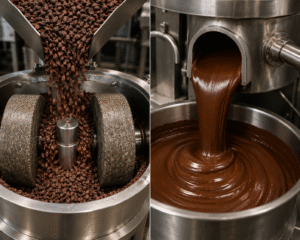
After winnowing, the cocoa nibs move to the grinding stage, where they are finely milled using industrial grinders.
During grinding, the natural cocoa butter inside the nibs melts because of the heat generated by friction, creating a smooth, thick liquid known as Cocoa Mass (also called cocoa liquor). Despite its name, cocoa liquor contains no alcohol—it is simply pure ground cocoa.
Cocoa mass contains approximately 50–55% cocoa butter and is the key ingredient used in manufacturing a variety of cocoa products and couverture chocolate.
The quality of cocoa mass depends heavily on the consistency of the grinding process, particle size, and the quality of the cocoa nibs.
Advantages of High-Quality Cocoa Mass
- Rich cocoa flavor.
- Smooth texture.
- High cocoa solids.
- Excellent consistency.
- Ideal for chocolate and industrial food production.
At Walksea Industries, cocoa mass is produced under carefully controlled manufacturing conditions to deliver consistent performance for food manufacturers and confectionery businesses.
Explore our premium Cocoa Mass, manufactured for bakery, confectionery, beverage, and industrial food applications.
Step 9: Separating Cocoa Butter and Cocoa Powder
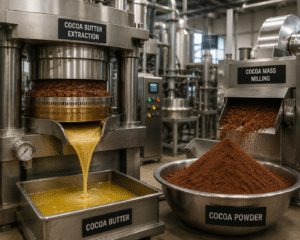
The final stage of cocoa processing involves separating cocoa mass into two valuable ingredients—Cocoa Butter and Cocoa Powder.
The cocoa mass is fed into a hydraulic press that applies extremely high pressure. This process extracts the natural cocoa butter while leaving behind a compressed solid known as the cocoa press cake.
The press cake is then pulverized into fine cocoa powder using specialized milling equipment. This single process produces two of the world’s most widely used cocoa ingredients.
Cocoa Butter
Cocoa butter is the natural fat extracted from cocoa beans. It is widely used in:
- Premium chocolate manufacturing
- Bakery products
- Ice cream
- Cosmetics
- Skincare products
- Pharmaceuticals
Its smooth texture, pleasant aroma, and excellent melting characteristics make it highly valuable across multiple industries.
Explore our premium Cocoa Butter for food and cosmetic applications.
Cocoa Powder
Cocoa powder is produced after the remaining press cake is finely ground into powder.Depending on the manufacturing process, cocoa powder may be:
- Natural Cocoa Powder
- Alkalized (Dutch Process) Cocoa Powder
It is commonly used in:
- Cakes
- Cookies
- Brownies
- Ice Cream
- Milkshakes
- Hot Chocolate
- Protein Foods
- Bakery Mixes
- Beverage Premixes
Walksea Industries offers premium cocoa powder suitable for commercial food production and industrial applications.
Discover our premium Cocoa Powder, available for bakery, confectionery, beverages, and food manufacturing.
Quality Control Throughout Cocoa Bean Processing
Producing premium cocoa ingredients requires strict quality control at every stage of the manufacturing process.
Key quality checks include:
- Moisture content testing
- Bean size grading
- Fermentation monitoring
- Roasting temperature control
- Microbiological testing
- Heavy metal testing (where applicable)
- Particle size analysis
- Packaging inspection
Maintaining these standards ensures that cocoa ingredients meet the requirements of food manufacturers, bakeries, confectionery brands, and beverage companies worldwide.
At Walksea Industries, quality assurance is integrated into every stage of production to deliver safe, consistent, and high-performing cocoa products.
Applications of Processed Cocoa Products
The cocoa ingredients produced through this manufacturing process are used across numerous industries.
Bakery Industry
- Cakes
- Brownies
- Muffins
- Cookies
- Pastries
Confectionery Industry
- Chocolate
- Truffles
- Fillings
- Ganache
- Pralines
Beverage Industry
- Hot Chocolate
- Instant Drink Mixes
- Milkshakes
- Coffee Blends
- Protein Drinks
Dairy Industry
- Ice Cream
- Frozen Desserts
- Chocolate Milk
- Yogurt
Food Manufacturing
- Dessert Mixes
- Snack Foods
- Breakfast Cereals
- Nutritional Products
The versatility of cocoa ingredients makes them indispensable across the global food industry.
Why Choose Walksea Industries for Premium Cocoa Products?
When sourcing cocoa ingredients, quality, consistency, and reliability are essential. At Walksea Industries, we are committed to delivering premium cocoa products that meet the evolving needs of the food and beverage industry.
Our advanced processing practices, strict quality standards, and customer-focused approach enable us to supply cocoa ingredients that perform consistently across bakery, confectionery, beverage, dairy, and industrial food applications.
What Makes Walksea Industries Different?
✅ Premium-quality cocoa ingredients sourced from carefully selected cocoa beans.
✅ Strict quality control throughout the cocoa bean processing journey.
✅ Consistent flavor, color, and functionality across every batch.
✅ Bulk supply for manufacturers, bakeries, HORECA, and food processing industries.
✅ Reliable packaging and timely deliveries.
✅ Wide portfolio of cocoa products under one trusted supplier.
Explore Our Products
- Cocoa Beans
- Cocoa Powder
- Cocoa Butter
- Cocoa Mass
- Cocoa Nibs
- Cocoa Husk
- Couverture Chocolate
Visit www.walkseaindustries.com to learn more about our complete range of cocoa ingredients.
Frequently Asked Questions (FAQs)
- What is cocoa bean processing?
Cocoa bean processing is the step-by-step manufacturing process that converts freshly harvested cocoa beans into valuable cocoa ingredients such as cocoa mass, cocoa butter, and cocoa powder. The process includes harvesting, fermentation, drying, roasting, grinding, and pressing.
- How long does the cocoa bean processing take?
The complete process usually takes one to two weeks, depending on fermentation time, drying conditions, and industrial manufacturing methods.
- Why is fermentation important in cocoa processing?
The cocoa bean fermentation process develops the characteristic cocoa flavor and aroma while reducing bitterness and preparing the beans for roasting.
- What happens during the cocoa bean roasting process?
Roasting enhances the cocoa’s flavor, aroma, and color while reducing moisture and making the shells easier to remove before grinding.
- What products are made from cocoa beans?
Processed cocoa beans are used to produce:
- Cocoa Powder
- Cocoa Butter
- Cocoa Mass
- Cocoa Nibs
- Couverture Chocolate
- Cocoa Husk
- What industries use cocoa products?
Cocoa ingredients are widely used in:
- Bakery
- Confectionery
- Dairy
- Beverage Manufacturing
- Ice Cream Production
- Food Processing
- HORECA
- Nutritional Foods
- Does Walksea Industries supply cocoa products in bulk?
Yes. Walksea Industries supplies premium-quality cocoa products in bulk for manufacturers, wholesalers, bakeries, confectionery brands, cafés, hotels, restaurants, and food processing industries.
Conclusion
Understanding how cocoa beans are processed helps us appreciate the craftsmanship and precision involved in producing high-quality cocoa ingredients. Every stage of the cocoa bean processing journey—from harvesting and fermentation to roasting, grinding, and pressing—plays a vital role in creating products that deliver exceptional flavor, texture, and performance.
Whether you’re a bakery, chocolate manufacturer, beverage producer, or food processing company, choosing high-quality cocoa ingredients starts with selecting a trusted supplier.
At Walksea Industries, we are dedicated to delivering premium cocoa products that meet the highest standards of quality, consistency, and reliability. Our comprehensive range of cocoa ingredients is designed to support businesses across the food industry with dependable supply and exceptional product performance.